Buyer information, not installation instructions. Requirements depend on the adopted local code and exact product. Electrical work and site diagnosis should be performed by qualified professionals.
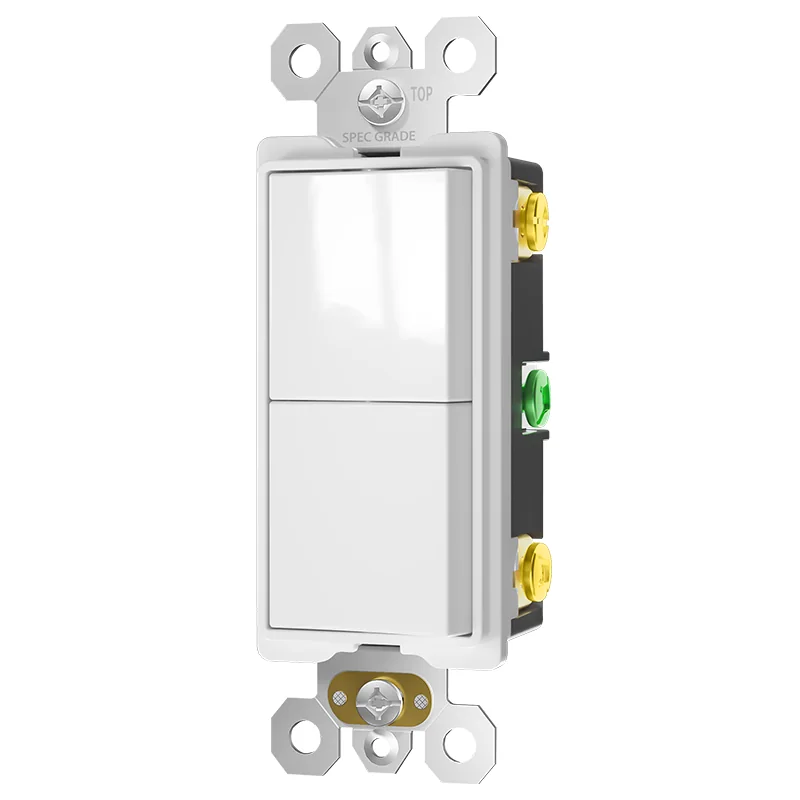
DS1502 puts two single-pole rockers in one device position; DS1503 puts three there. They provide separate on/off controls for separate loads, such as ceiling lights and wall lights at a room entrance.
Two loads or two control locations?
Count loads and control locations separately. A 3-way circuit lets the same load be controlled from two locations. For that function, review DS15.3. DS1503’s three rockers each provide single-pole control. [Source]
| Model | Controls on the device | Published function |
|---|---|---|
| DS1502 | Two rockers | Two single-pole controls |
| DS1503 | Three rockers | Three single-pole controls |
| DS15.3 | One paddle | 3-way switching |
Combination configurations vary across manufacturers. ENERLITES, for example, lists dual single-pole and dual 3-way versions separately. Use the stated function as well as the rocker count when comparing products. [Source]
The device still occupies one gang
DS1502 and DS1503 are single-gang devices. Choose the wallplate by the device opening and mounting position, rather than ordering a two- or three-gang plate from the number of rockers.
Review the switch and plate as an assembled sample. The installer also needs to check wall-box space and the conductors for the planned loads.
State the load behind each rocker
Both combination models have a published device rating of 15A, 120/277V AC. The rocker count does not multiply that rating. Obtain the applicable per-circuit and combined-load limits for the selected model. [Source]
If a rocker will operate a fan, heater or other equipment, name its model and load in the request. These are on/off controls; dimming and fan-speed control require their own suitable devices.
For a DS1502 inquiry, a simple control schedule might read “upper rocker: ceiling lights; lower rocker: wall lights,” followed by the equipment details, finish, plate and quantity. Keep the same arrangement in the approved sample and room schedule.
One strap, two loads: the plate is where orders go wrong
DS1502 and DS1503 put two or three rockers on a single strap that occupies one gang. The rocker count is a device property; the plate opening count is a plate property; and the two are not the same number. A two-rocker combination device takes a single-opening plate, because the plate surrounds one strap, not two devices.
The most common configuration we quote is a bathroom where one rocker drives the light and the other drives the fan. Both loads sit behind the same strap, so the total connected load is the sum, and a fan with a high inrush is the part that decides whether the device is suitable. Give the fan model, not just its wattage.
The range has no three-way combination device. If one of the two loads has to be switched from a second location, that load needs its own three-way circuit and a separate DS15-3 or T15-3 at each end. Trying to solve it with a combination device produces a plan that cannot be wired.
Write the line as the model, the rocker layout, the load behind each rocker, the finish and the matching single-opening plate. When a quantity arrives without the rocker layout, the order is one message away from being wrong.
Sources & further reading
Reviewing a specific model?
Send the model and the question you want to resolve. We will help locate the relevant product information.
Ask a product question